Showing posts with label Poetry. Show all posts

Monday, 25 March 2013

In Flanders Field

Image

In Flanders fields the poppies blow
Between the crosses, row on row,
That mark our place; and in the sky
The larks, still bravely singing, fly
Scarce heard amid the guns below.

We are the Dead. Short days ago
We lived, felt dawn, saw sunset glow,
Loved and were loved, and now we lie
In Flanders fields.

Take up our quarrel with the foe:
To you from failing hands we throw
The torch; be yours to hold it high.
If ye break faith with us who die
We shall not sleep, though poppies grow
In Flanders fields. 

~ John McCrae, 1915

Sunday, 3 February 2013

You Give Me Hope

Image

You give me hope 
for a brighter tomorrow,
an angel guiding me 
out of my sorrow.

My fears I want to break free
and my insecurities to let go,
but can my troubled past 
or a life of hurt I forgo?

I ask you this 
as you grow in my heart,
Always be there 
so we may never part. 

I have very little to offer you,
and even less to give,
Yet my soul I give unto you 
and my every day, for us both to live.

Let us embrace this, our new life 
and for what it has to give,
Through the depths of sorrow 
you have taught me again to live. 

© 2013, Ryan Price (02/02/2013)   
       ~ for B, on his birthday. 

contra omnia discrimina 

Wednesday, 30 January 2013

Close Your Eyes

Image

I can't be with you today
but if you close your eyes and think;
I'll be beside you in the kitchen
wearing your shirt - standing by the sink.

I'll be with you in the bedroom
waiting quietly on your bed;
Just close your eyes and think of me,
relive those memories in your head.

I'll stand by you in the bathroom,
an unlikely place to meet;
I'll smile at you so playfully
as I let you brush my teeth.

I'll be your light in the darkness,
shining steady through and through;
You only have to watch it glow
to know I think of you.

I'll be the music that you listen to,
I'll be there in every song:
I'll laugh with you and sing with you,
and comfort you when your day's gone wrong.

I'll be the wind that ruffles your hair,
I'll be that warm embrace;
I'll be the hand on your shoulder,
I'll be the tender touch on your face.

I'll be the clock gently ticking,
reminding you of the times;
We've shut the rest of the world outside
we're in our own world - yours and mine.

I'll be the moon as it dances
on the water cold and still;
For I have loved you always
and I know I always will.

Though you may not see me physically
as you live your life today;
Just close your eyes and think of me
I will not be far away.

Saturday, 12 January 2013

POETRY: I AM STILL HERE

Once, my tortured tangled heart,
Ached alone, hurt and weeping,
Yearning for the company I was seeking,
Pushed away by the one I was keeping. 

He walked out on me without a clue,
And summer lost its brightest hue,
No explanation, just desperation,
To return to a life he once knew. 

Autumns day was short and fast,
His pseudo-love for me would not last,
Yet still I kept and provided for him,
Even when winters evening grew so dim.

For him the grass was always greener,
His desire for a greater life now keener,
I fought too hard and bore the scars,
To keep a man already lost, in eternal spring.

I feel no pity for this man,
No longer do I love or hate him,
Indifference is now my only feeling,
My beating heart no longer reeling.

The light of a clear blue morning beckons,
In this life I've learned many lessons,
The sun again has shown to me its face,
And now no longer will I fall from grace. 

He is gone but I am still here,
Yet no care nor anything do I now feel,
All he left was a comma, on a blotted page,
In a fairytale chapter of a long ago age. 

~ Ryan Price

© 2013 Ryan J. A. Price (11/01/2013)
all rights reserved. No copying or reproduction in whole or part without the express written permission of the author. 

Contra Omnia Discrimina 

Tuesday, 4 December 2012

Christmas Cards: A Poem

Image

CHRISTMAS CARDS

Slip through the letter box with messages:
Some bland, some more intense, some aching with
Bereavements, wives abandoned, loss of jobs.

The annual contact on a patient card.
‘See you next year’ some say and quite forget
Before the ink is dry. A plaster patch

That leaves no sticky mark on minor wounds
However much the cover faces please
With coloured art or kitsch or nearly art.

One threatens every time in wiry script
‘This is the last card I shall send.  I am
Too old now’.  Still it slides into my hand.

And there is one that comes anonymous,
Unsigned, the postmark adds its mystery,
A smudge, a ghost behind this paper mask?

Perhaps there’ll be a few to tuck away
After the show, in an old envelope,
Fingered at times because the sender once

Carved hope into a fraction of your years;
Or others will imply ‘I am still here’ -
A comma on your page a life ago.

~ contra omnia discrimina

{for my friend, Chris - who's comma was indeed an open chapter}

Friday, 28 September 2012

Autumn in Literature

Image
William Shakespeare personified autumn in Sonnet 73:

“That time of year thou mayst in me behold

When yellow leaves, or none, or few, do hang

Upon those boughs which shake against the cold,

William Blake - “O autumn laden with fruit” - and John Keats with his “Season of mists and mellow fruitfulness”  both wrote odes “To Autumn”.

In the simply-titled “Autumn” John Clare noted “The summer-flower has run to seed / And yellow is the woodland bough / And every leaf of bush and weed / Is tipt with autumn’s pencil now”.

Elizabeth Barrett Browning told us in “The Autumn” that “Waving woods and waters wild / Do hymn an autumn sound”, while a poet she influenced, Dante Gabriel Rossetti, wrote “Know’st thou not at the fall of the leaf / How the heart feels a languid grief” in “Autumn Song”. 

Some of these celebrate the maturing year while others mourn its aging. It’s a matter of state of mind and art.

The less familiar Anglo-Welsh poet Edward Thomas also addressed the theme of falling leaves and an end of things in his more month-specific poem “October”:

“The green elm with the one great bough of gold 

Lets leaves into the grass slip, one by one, -- 

The short hill grass, the mushrooms small milk-white, 

Harebell and scabious and tormentil, 

That blackberry and gorse, in dew and sun, 

Bow down to; and the wind travels too light 

To shake the fallen birch leaves from the fern…”

But leave it to Edgar Allan Poe in “Ululame” most mournfully to use the month as a metaphor for sorrow and loss, particularly referencing the death of a woman – a subject distressingly close to Poe:

“The skies they were ashen and sober;

The leaves they were crisped and sere - 

The leaves they were withering and sere;

It was night in the lonesome October

Of my most immemorial year….”

There are more optimistic opinions of October, of course. Helen Hunt Jackson (1830-1885) reckoned that “Suns and skies and clouds of June / And flowers of June together / ye cannot rival for one hour / October’s bright blue weather”.  

The great bucolic New England poet Robert Frost seemed to have mixed feelings in “October”, concentrating on the stillness and maturation of the month, the gradual shortening of the days and the almost teasing, nature of the slow turn towards winter, beseeching the month to keep the harsher weather at bay: 

"O hushed October morning mild,

Begin the hours of this day slow.

Make the day seem to us less brief.

Hearts not averse to being beguiled,

Beguile us in the way you know.

Release one leaf at break of day;

But to end on a thoroughly cheery note, here are words from “Old October” by a poet from the American Midwest, James Whitcomb Riley (1849-1916). He was known as the “Hoosier Poet”, often writing in Indiana dialect which we can follow well enough.  

Like Edward Thomas he cites the elm tree in the first few lines:

“Old October's purt' nigh gone,

And the frosts is comin' on

Little HEAVIER every day--

Like our hearts is thataway!

Leaves is changin' overhead

Back from green to gray and red,

Brown and yeller, with their stems

Loosenin' on the oaks and e'ms;

And the balance of the trees

Gittin' balder every breeze--

Like the heads we're scratchin' on!

Old October's purt' nigh gone.”

But Riley is not lamenting the onset of October, rather its ending, likening this to the departure of a friend. Hickory nuts falling, he suggests, are the sound of tears falling at the sadness of this departure:

"I love Old October so,

I can't bear to see her go--

Seems to me like losin' some

Old-home relative er chum--

'Pears like sorto' settin' by

Some old friend 'at sigh by sigh

Was a-passin' out o' sight

Into everlastin' night!

Hickernuts a feller hears

Rattlin' down is more like tears

Drappin' on the leaves below--

I love Old October so!"

Wednesday, 26 September 2012

John Vance Cheney: Tears & The Happiest Heart

Image

Tears (1892)

  • Not in the time of pleasure
    Hope doth set her bow;
    But in the sky of sorrow,
    Over the vale of woe.

    Through gloom and shadow look we
    On beyond the years!
    The soul would have no rainbow
    Had the eyes no tears.

    • The Century Vol. 44, Issue 4 (August 1892)

The Happiest Heart

  • Who drives the horses of the sun
    Shall lord it but a day;
    Better the lowly deed were done,
    And kept the humble way.
  • The rust will find the sword of fame,
    The dust will hide the crown;
    Ay, none shall nail so high his name
    Time will not tear it down.
  • The happiest heart that ever beat
    Was in some quiet breast
    That found the common daylight sweet,
    And left to Heaven the rest.

Tuesday, 8 May 2012

Kahlil Gibran on Love

Image

<p><img src="

Media_httpimg686image_jipfu
" border="0" alt="" /></p>
When love beckons to you, follow him,
Though his ways are hard and steep.
And when his wings enfold you yield to him,
Though the sword hidden among his pinions may wound you.
And when he speaks to you believe in him,
Though his voice may shatter your dreams
as the north wind lays waste the garden. 

For even as love crowns you so shall he crucify you. Even as he is for your growth so is he for your pruning.
Even as he ascends to your height and caresses your tenderest branches that quiver in the sun,
So shall he descend to your roots and shake them in their clinging to the earth. 

Like sheaves of corn he gathers you unto himself.
He threshes you to make you naked.
He sifts you to free you from your husks.
He grinds you to whiteness.
He kneads you until you are pliant;
And then he assigns you to his sacred fire, that you may become sacred bread for God's sacred feast. 

All these things shall love do unto you that you may know the secrets of your heart, and in that knowledge become a fragment of Life's heart. 

But if in your fear you would seek only love's peace and love's pleasure,
Then it is better for you that you cover your nakedness and pass out of love's threshing-floor,
Into the seasonless world where you shall laugh, but not all of your laughter, and weep, but not all of your tears.
Love gives naught but itself and takes naught but from itself.
Love possesses not nor would it be possessed;
For love is sufficient unto love. 

When you love you should not say, "God is in my heart," but rather, "I am in the heart of God."
And think not you can direct the course of love, for love, if it finds you worthy, directs your course. 

Love has no other desire but to fulfill itself.
But if you love and must needs have desires, let these be your desires:
To melt and be like a running brook that sings its melody to the night.
To know the pain of too much tenderness.
To be wounded by your own understanding of love;
And to bleed willingly and joyfully.
To wake at dawn with a winged heart and give thanks for another day of loving;
To rest at the noon hour and meditate love's ecstasy;
To return home at eventide with gratitude;
And then to sleep with a prayer for the beloved in your heart and a song of praise upon your lips.
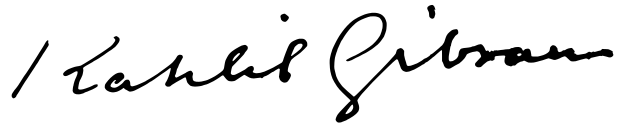
<p><img src="http://upload.wikimedia.org/wikipedia/commons/c/c4/Kahlil_Gibran_signature.svg" border="0" alt="" /></p>
Khalil Gibran

Posted via email from uselessdesires

Sunday, 6 May 2012

Khalil Gibran: Love One Another


Love one another, but make not a bond of love.
Let it rather be a moving sea between the shores of your souls.
Fill each other's cup, but drink not from one cup.
Give one another of your bread, but eat not from the same loaf.
Sing and dance together and be joyous, but let each one of you be alone.
Even as the strings of a lute are alone though they quiver with the same music.
Give your hearts, but not into each other's keeping.
For only the hand of life can contain your hearts.
And stand together, yet not too near together.
For the pillars of the temple stand apart.
And the oak tree and the cypress grow not in each other's shadow.


Khalil Gibran

Posted via email from uselessdesires

The Lovers, by Abu Nuwas (Persia) Circa 800 A.D.

Image
Blessed indeed are these two loving friends; 
They sleep through the night, 
in an embrace without end.

They have loved each other since birth, so they say; 
With strong, equal loves, 
alike all the way.

When Love came to them, they told him what to do: 
“Do the right thing, 
Love and split Love in two!”

So Love split himself, 
in two equal parts; Hard work! 
But no thwarting those strongly-knit hearts.

Their two souls became one soul, and then; 
That one soul lived in the two loving men.

These two don’t quarrel; 
they avoid any strife; 
They guard their love as more precious than life.

by Abu Nuwas, Persia, Circa 800 A.D.

*  *  *

For us, and for Franky Dolan & Randy Ordonio

Posted via email from uselessdesires

Monday, 29 August 2011

Poem: Time to Stop and Stare

What is this life if full of care

We have no time to stand and stare?

No time to stand beneath the boughs

And stare as long as sheep, or cows.

No time to see, when woods we pass,

Where squirrels hide their nuts in grass.

No time to see, in broad daylight,

Streams full of stars, like skies at night.

No time to turn at Beauty's glance,

And watch her feet, how they can dance.

No time to wait till her mouth can

Enrich that smile her eyes began.

A poor life this, if full of care,

We have no time to stand and stare.


© William Henry Davies 1871 - 1940


~ Contra Omnia Discrimina

Posted via email from uselessdesires

Thursday, 4 August 2011

Charles Hamilton Sorley: The Song of the Ungirt Runners

P1210

We swing ungirded hips,
And lightened are our eyes,
The rain is on our lips,
We do not run for prize.
We know not whom we trust,
Nor whitherward we fare,
But we run because we must,
Through the great wide air.

The waters of the seas,
Are troubled as by storm.
The tempest strips the trees,
And does not leave them warm.
Does the tearing tempest pause?
Do the tree-tops ask it why?
So we run without a cause,
'Neath the big bare sky.

The rain is on our lips,
We do not run for prize.
But the storm the water whips,
And the wave howls to the skies.
The winds arise and strike it,
And scatter it like sand,
And we run because we like it,
Through the broad bright land.

© Charles Hamilton Sorley

contra omnia discrimina, amor vincit omnia

Posted via email from uselessdesires

Wednesday, 16 February 2011

Poetry: Forever Valentine #1

With a heart so purely fine,
And so sweet a love - divine,
I dared to dream - you’ll be mine,
Only - forever - valentine.

So, I offer you the sweetest wine,
Nothing but the finest fruit of the vine,
Keenly rejecting all others as brine,
For you - forever- valentine.

Scared, I dreamed of life sublime, And now at last - the dream is mine,
Catch my heart each moment in time,
In love - forever - my valentine. Cling to me my love - and entwine,
Feast with me, my sweet - and dine,
Always together - the grand design,
Our love - forever - eternal valentine.

Copyright © Ryan Price, 2011
All rights reserved.

Posted via email from uselessdesires

Tuesday, 18 January 2011

She is Gone - A Poem

You can shed tears that she is gone,
or you can smile because she has lived.

You can close your eyes and pray that she’ll come back,
or you can open your eyes and see all she’s left.

Your heart can be empty because you can’t see her,
or you can be full of the love you shared.

You can turn your back on tomorrow and live yesterday,
or you can be happy for tomorrow because of yesterday.

You can remember her and only that she’s gone,
or you can cherish her memory and let it live on.

You can cry and close your mind,
be empty and turn your back,
or you can do what she’d want:
smile, open your eyes, love and go on.

David Harkins, © 1981
Silloth, Cumbria, UK

•••

Included by the Queen on the order of service for the Queen Mother's funeral on Tuesday 9th April 2002, the poem 'She Is Gone' was credited to 'Anon'. Her Majesty was said to have encountered the work at the funeral of the late" Dowager Viscountess De L'Isle, whose family had found the poem in a small anthology published in 1999.

After the Queen Mother's funeral much effort went into attempts to identify the author, with attributions going to, among others Immanuel Kant and Joyce Grenfell, before the author was discovered to be former baker David Harkins from Cumbria. David Harkins had written the piece in the early eighties, though not as a funeral oration, but in homage to an unrequited love.

David Harkins wrote to The Daily Mail on Tuesday January 14th 2003 as follows:- 'I was 23 when I first met Anne LLoyd, my inspiration for the poem I called Remember Me.
She was 16 and didn't know me, but had seen her about and knocked on her door one evening in November 1981. Anne answered, and I introduced myself as a painter (painting was a hobby of mine back then) and asked her to pose.
She agreed, and I returned on the Thursday evening, when I made feeble attempts to sketch Anne. This proved difficult as her mother was present throughout.
Anne posed for me about eight times, and we met regularly for a couple of years and talked a great deal, though we never even kissed, which is probably why I poured all my feelings about her into my poetry.
I completed Remember Me in about March 1982, but until last year none of my poems received any recognition. Pam, a one act play from 1987, was my last piece of work inspired by Anne.
Shortly afterwards I met Jayne, my wife, and I have not seen Anne since. My writing has dried up and I'm now a painter selling my works on the internet.'
David Harkins, Silloth, Cumbria.

Further Foot Note:

News & Star 12/09/2002 I wrote the Queen Mum's funeral poem By Chris Musson THE mystery author of a poem which was read out at the Queen Mother's funeral can now be revealed as a Cumbrian man who wrote it more than 20 years earlier when he was a young bakery worker. The poem was recited at the royal funeral earlier this year and sparked a glut of media interest because of its simple, upbeat nature - and mystery author. The Queen had found the poem while leafing through old memorial service books and she chose it to be read at her mother's funeral at Westminster Abbey in April, where it struck a chord with millions of mourners. Today the News & Star can reveal that Silloth man David Harkins wrote the poem in 1981 while working at Robertson's bakery in Durranhill, Carlisle. Mr Harkins, 43, has since received a letter of thanks from the Prince of Wales. The discovery finally ends a nationwide media hunt for the poem's author. Mr Harkins, who now works as an artist selling paintings over the Internet, said he "couldn't believe his eyes" when he saw his poetry published in newspapers after the funeral. Shocked He had sent the original manuscript of the poem to Prince Charles, and St James's Palace replied thanking Mr Harkins for explaining its origin. He said: "I wrote it in 1981. It was about a girl and I called it Remember Me. Since then, it's been changed to suit different people and also altered slightly for funerals. "I was shocked. I only found out about it at the time of the Queen Mother's funeral and I couldn't believe it. My wife Jayne and I were reading the newspapers and there it was. "She said to me something like 'that's your poem!'. There were changes but they were just words - a word here and a word there. "So I sent the original copy to Prince Charles in May and got a lovely letter of reply." The reply from Prince Charles' then private secretary, Stephen Lamport, thanks Mr Harkins for providing the history of the "passage which captured the hearts of so many people when it was published as part of Queen Elizabeth's funeral service". At the time the poem was written, he was working at Robertson's bakery, while living in Scalegate Road, Upperby. Mr Harkins said: "I laugh about it because death is not what it's about. It wasn't written for a funeral. I wrote it about a girl I lusted after but she couldn't stand the sight of me. "It was nothing to do with anyone dying but at the same time, I am humbled by the fact that anyone should use it at a funeral, especially for the Queen Mother. "It was straight from the heart and when I think about it, I'm both proud and not proud. I have sent it to people and they always try to put it into poetry but it isn't. It was just poetic prose." It is thought Remember Me - one of many pieces Mr Harkins has sent to publishers and newspapers over the years - found its way onto the Internet and into memorial booklets like the one spotted by the Queen. After the funeral, the poem was subjected to the scrutiny of the national media, with some critics ridiculing its apparent lack of literary merit. The reply from the Prince of Wales's office continued: "I have no doubt that it will be reproduced on many occasions over the years to come. The Prince of Wales has asked me to send you his very best wishes." Chris Musson Reporter, The Cumberland News / News & Star

An interesting link if you need more information on 'She is Gone' and the author http://www.bbc.co.uk/dna/ww2/A2174735

Posted via email from uselessdesires

Monday, 17 January 2011

I Care - A Poem by Ryan Price, for CA

If I could
If Only for a moment,
Take your pain and make it mine,
I would.

If I could
Carry your heavy load,
Ease the sorrow you have,
I would.

If I could
Give you a reason for this,
Tell you why this is happening,
I would.

I would do anything to remove your hurt,
But sometimes the rocky road of life,
Twists and turns, goes uphill and down,
And the whole world seems cold and heartless.

If I could
Shelter you from all of this,
Wrap you up and comfort you,
I would.

If nothing else,
Remember this;
I’m here,
If you want to talk,
If you need to cry,
If you can find comfort from sharing silence with me,
I’m here,
I care.

© 1998 - 2010 Ryan Price

Posted via email from uselessdesires

Saturday, 15 January 2011

A Poem About Mice by W R Espy

A mouse of my acquaintance in seven days was fed

Twice twenty thousand swordfish, and now that mouse is dead.

The mercury in swordfish is an enemy to dread.

He ate twice twenty thousand, and that mouse is dead.

His sister gnawed through pizzas (I’m told one million four).

There’s talk of botulism, and that sister is no more.

Their brother downed ten thousand turkeys lined with pesticide.

It took a week to kill him, but that poor mouse died.

So stay away from hormones, and from salmonella too,

Be impolite to cyclamates, and DDT eschew,

For additives and chemicals can kill you just like that,

Though (confidentially) those mice were done in by the cat.

Courtesy of:
http://weirdsid.tumblr.com/post/2758745039/a-poem-about-mice-by-w-r-espy

contra omnia discrimina

Posted via email from uselessdesires

Thursday, 2 December 2010

I, The Fool

Hopelessly bound,
unfettered,
by the chains of love's grip;
the greatest gift,
yet fate's cruelest curse.

Why do I weep?
at knowing the joy,
the warmth,
at feeling the peace,
the flame,
the fire.

Why do I weep?
unable to be complete Unable to just 'be,'
unknown to the kiss,
the flame.

Why do I weep
at loving, not living
seeing, not touching
breathing, not sharing
holding, not loving?

All,
because I, The Fool,
Deserve love no more?

Copyright © Ryan Price, December 2010

Posted via email from uselessdesires